
Our hangars are designed with a large span and do not require a foundation, being suitable for all types of aircraft. From jet aircraft to helicopters – a modern modular design makes it possible to protect and maintain aircraft in the most challenging conditions.
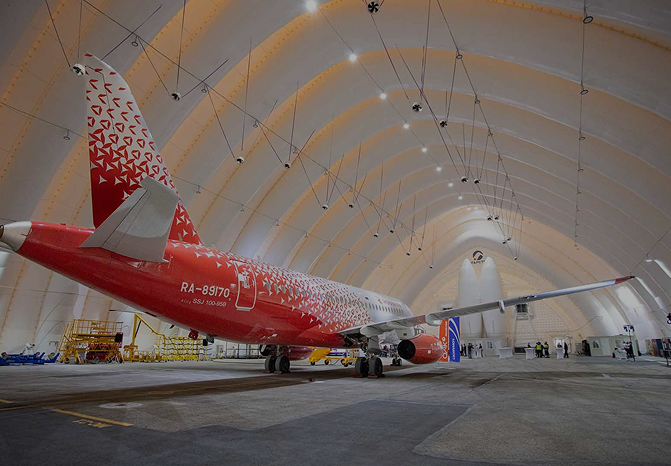
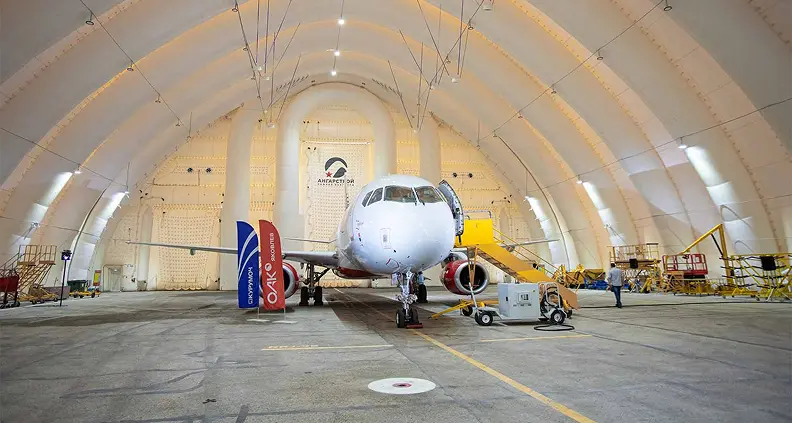
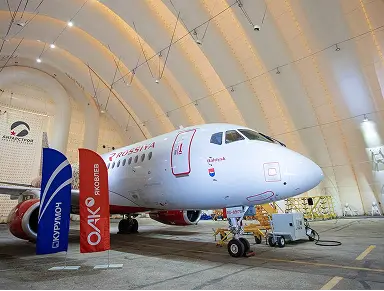
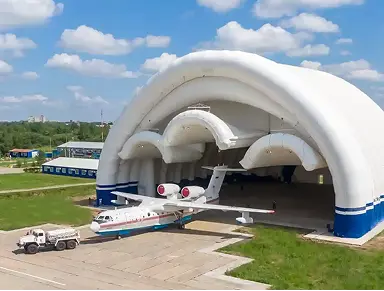
An inflatable aircraft hangar is a pneumatic mobile structure that can be built at almost any location. No foundation is needed for installation, and the whole process lasts a little over an hour, and the procedure for filling the walls with air takes no more than 15 minutes.
What advantages are relevant for an inflatable airplane hangar:
Saving resources for the maintenance of the building. First of all, electricity costs are reduced if we compare the inflatable structure with traditional aviation analogues, because the synthetic material is able to pass up to 90% of the sun’s rays, so the illumination level is quite high throughout the day. UV radiation does not cause any harm to people inside such a structure, since the membrane effectively reflects it. Low cost of aircraft maintenance. Equipment located in the open air wears out much faster when compared with aircraft in hangars. Inflatable protection will reduce the rate of depreciation, as well as make the repair process more comfortable. You will not have to worry about the condition of the vehicle at any time of the year, since aviation pneumatic hangars are supplemented with heating and air conditioning systems.
The risk of corrosion on the elements of the aircraft body is reduced. Aviation transport stored outside hangars is subject to the constant influence of precipitation, high humidity, industrial gases, salt particles and dust. Inside the inflatable structure, the equipment will be in a completely sealed space, where ideal conditions will be maintained with the help of modern air performance adjustment systems.
The aircraft hangar is sufficiently well protected from mechanical damage, even the air intakes are closed with a grille, which prevents foreign elements from entering the pumping system and, as a result, into the inflatable structure. During the preparation of the project, the height of the placement of air intake nozzles is also discussed.
Swap systems do not require regular maintenance, so you will not have to hire additional specialists to work with air intakes. The power of this equipment depends on the size of the pneumatic tank, and its performance is maintained even at sub-zero air temperatures and during heavy rainfall.
Inflatable airplane hangars are suitable for various types of aviation, including large aircraft or private helicopters. The structures differ from each other only in the size and power of the air intakes. It is also important to provide space inside the structure for carrying out repairs, including regular maintenance of transport.
The hangar for an airplane is the largest structure, if we consider pneumatic structures. Inflatable buildings are often ordered to accommodate private planes, the size of which is much smaller than civil aviation liners. This allows you to save on the cost of owning equipment, as it is enough just to rent a plot at an airport convenient for pilots and the owner.
Inflatable aircraft hangars are also suitable for larger equipment, since the sizes of models available for purchase are sufficient for comfortable placement of flying vehicles and for their maintenance. Planes can stay in them both year-round and during forced downtime.
Despite the seeming unreliability, the design with “air” walls meets all the requirements of aviation authorities. That is why such structures appear more and more often on the site of more expensive capital buildings.
Air–supported inflatable aircraft hangars are the best option for storing helicopters. They are easy to install on a limited-sized terrain, as well as where it is not possible to use capital structures due to exposure to the surface. The low cost of the product also plays a role.
An aviation hangar for helicopters allows you to store an aircraft vehicle while it is not involved in flights, as well as maintain and repair it. In the same room you can place a warehouse for spare parts, materials and tools.
The inflatable type aircraft hangar is available in sizes that meet the needs of customers. So, if there is a helicopter in it, then you will not have to make the room sufficient for parking the aircraft.
Therefore, each project is developed individually, taking into account the following characteristics:
what standards are established for the site on which the structure is located;
aircraft dimensions;
the need for a repair and storage area;
the number of flying vehicles.
The average width of such structures is 50 meters, the height is about 12 meters, while the customer can lay down parameters several times larger than those considered.
Inflatable airplane hangars, despite the apparent uniformity of their application methods, are still divided into groups that differ in purpose. The requirements for their construction also depend on this. What types of constructions are common:
The requirements apply to the following:
Inflatable aviation structures allow you to comply with all requirements for pre-fabricated and capital structures from the field of air transport.
Design is the main stage in the development of prefabricated structures for airplanes and helicopters, the implementation of which requires the use of specialized skills and knowledge. Even a small error in calculations can be fatal for expensive machinery and equipment.
For work, specialists use the “Instructions for the development of projects and estimates for industrial construction”, issued in accordance with the requirements of the Ministry of Civil Aviation. According to this document, the procedure for developing the structure is drawn up, and then projects and estimates for the construction or reconstruction of the structure are approved.
It is also important to carry out technical and economic calculations to determine the nomenclature, compositions and volumes of buildings being prepared. This is also relevant for inflatable aircraft hangars. It is important to lay down the tolerances for the possibility of making changes to technological processes, as well as for redesigning or refurbishing the future premises.
In a situation where a hangar is a production room at an airport, it is important to lay in the project the possibility of equipping the building with lifting equipment, as well as engineering–type equipment, so that the future owner can carry out the necessary operations.
The Angarstroy company is a developer and manufacturer of inflatable pneumatic hangars for the aviation industry, including for storing airplanes and helicopters. Our products are able to work in any climatic conditions, while they remain as cost-effective as possible, do not require regular maintenance, and are built faster than in one day.
To create and execute projects, we have our own staff of specialists, as well as production facilities with the latest equipment that allows us to produce more than 20 thousand square meters of products annually.
100 to 10,000 sqm
1.5 to 4 sqm
1 to 20 kw
1.8 to 100 t
Up to 45 m/s
1 to 7 days
10 to 100 m
7 to 30 m
70 to 1,550 kg
-60 to +70 °C
At least 15 years
Reinforced PVC
Translucent reinforced PVC materials ensure high light transmission of the structure and make it possible to do without artificial lighting in the daytime. Because the membrane transmits up to 90% of sunlight, the working space inside the hangar has a sufficient level of illumination without the use of additional light sources. The white color of the membrane helps reflect heat and ultraviolet radiation.
For irregularly used aircraft stored in the open air, the cost of maintenance and the rate of depreciation increase, subsequently leading to a decrease in the market value of aircraft in case of its secondary sale. We offer aircraft hangars in several standard sizes with heating ventilation and air conditioning systems, which will allow keeping the equipment in excellent condition for a long time and carry out high-quality maintenance.
There are always problems in the aviation industry with corrosion damage occurring on the casing of machines based on airfields located near industrial or coastal areas. Among the factors that sharply accelerate the corrosion process is increased humidity and atmospheric pollution with industrial gases, coal dust, and salt particles. Our hangars provide almost airtight storage of aircraft.
Our experts have been continuously working to improve our solutions. Employees of the company are always ready to provide you with information support and to assist in the installation, repair and operation of pneumatic hangars.

Each hangar is designed in close cooperation with the customer and our experts: designers, engineers and analysts, who already have over a hundred projects in their portfolio.
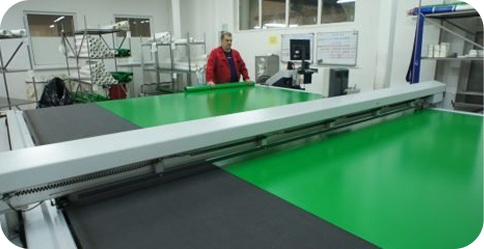
Hangars are manufactured on a production site of more than 5,000 square meters, equipped with state-of-the-art high-speed welding plants, digital milling cutters and plotters.
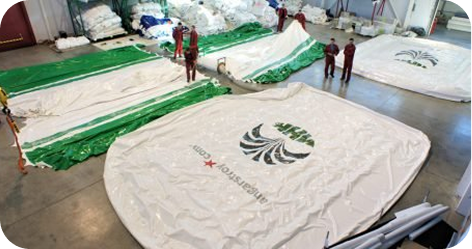
Packaging options depend on the means of delivery requested by the customer. For sea, rail and freight, we use 20- and 40-foot containers.

The company’s experts visit the installation site to assist in the deployment of the hangar, share theoretical knowledge and conduct practical exercises.
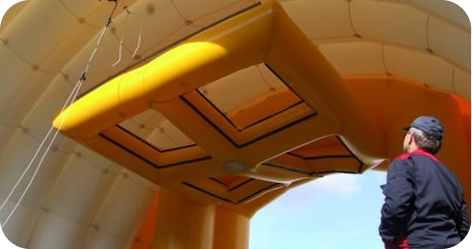
Installation of an inflatable hangar does not require foundation or earthwork. It is enough to have a more or less flat terrain. A team of 12 workers can deploy a hangar in 2 or 3 days.

You will be able to start using the hangar the very second after the installation. The hangar withstands strong gusts of wind, heat, cold and heavy snowfall.